
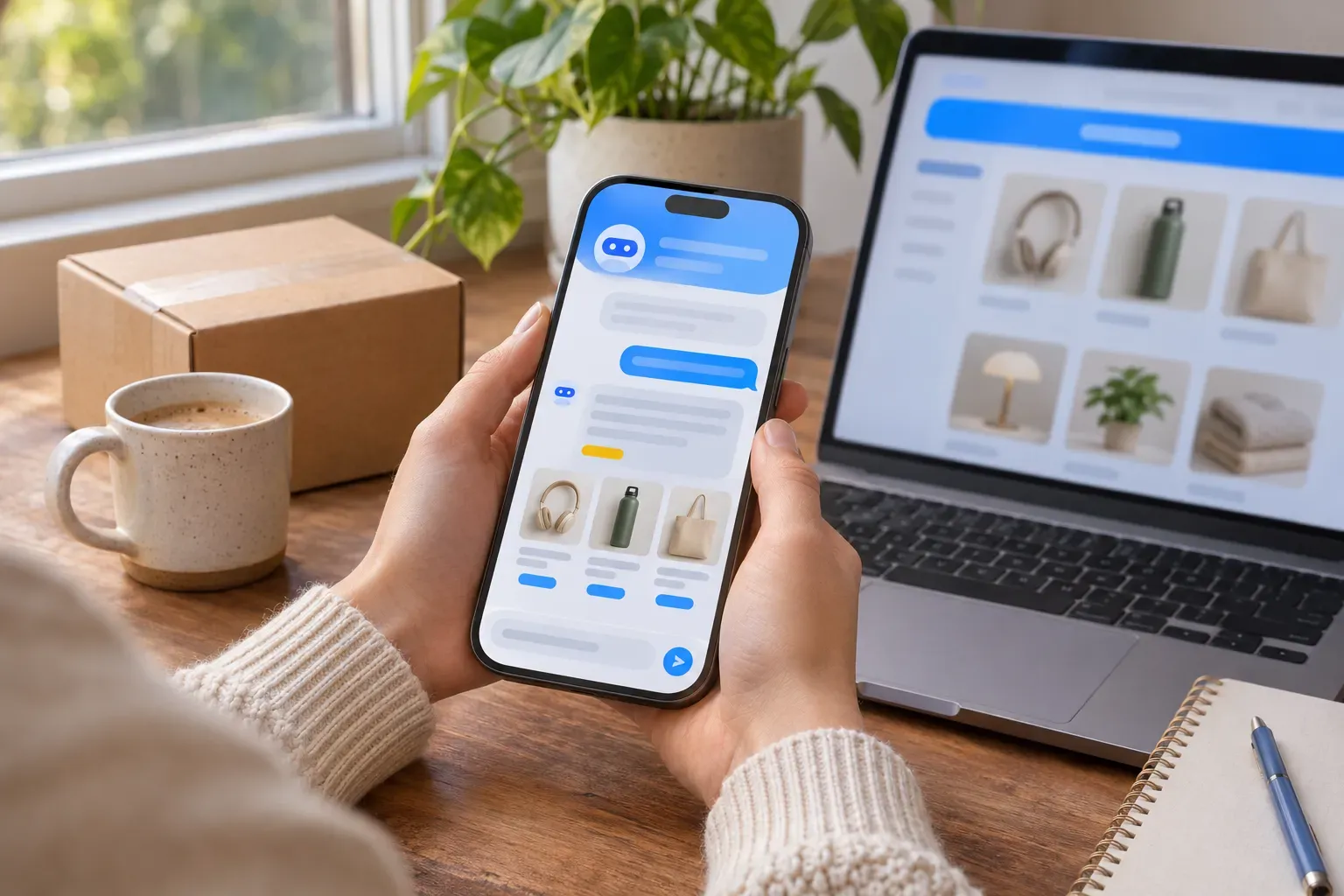
What Is an AI Shopping Assistant?
An AI shopping assistant uses natural language processing and machine learning to answer questions, interpret intent, and guide shoppers to relevant products. Instead of typing keywords, shoppers describe what they want in plain language and get personalized recommendations back.
That is a big shift from keyword matching, and it changes the whole shopping experience. It is often called conversational shopping. Traditional site search returns pages that contain the words you typed. An AI assistant tries to understand what you actually need.
Off-Site Shopping Assistants
Off-site shopping assistants live outside your store. ChatGPT, Google AI Mode and Gemini, Amazon Rufus, and Perplexity all help shoppers research, compare prices, and decide what to buy.
You don't control these AI assistants. Some now act as a shopping agent that can compare options and even complete a purchase. You can only influence what they know about your products.
On-Site Shopping Assistants
An on site assistant runs on your own online store. It answers customer questions, recommends products from your own catalog, and can handle order status and post purchase support.
These are tools a store owner buys and installs on the actual storefront. They are a newer take on the virtual assistants and chatbots stores have used for years. I cover when they make sense later in this guide.
How AI Shopping Assistants Differ From Site Search
Site search matches keywords. AI shopping assistants match intent.
A shopper might type "waterproof hiking boots" into site search. In an AI assistant, the same shopper writes, "I need waterproof hiking boots for wide feet, under $200, that work in snow." The assistant uses every detail to read shopper intent and narrow the options to relevant items.
How Many Online Shoppers Use AI Shopping Assistants?
A fast-growing share of online shoppers now use AI shopping assistants as part of online shopping, even if AI still drives less traffic than Google. Adobe found that traffic from generative AI tools to US retail sites rose 693% year over year during the 2025 holiday season.
Amazon reported that more than 300 million customers used Rufus, its AI shopping assistant, in 2025. Amazon says Rufus drove nearly $12 billion in incremental annualized sales.
Salesforce estimates that AI and agents influenced 20% of global orders during Cyber Week 2025, through product recommendations and conversational customer service.
One honest caveat: Adobe notes that AI referrals still start from a small base. Google remains the biggest source of organic traffic for most brands. But the trend line is steep, and the shoppers coming through AI are unusually valuable.
Why Do AI-Referred Shoppers Matter?
AI-referred shoppers matter because they arrive ready to buy. The assistant has already done the research, so the click lands much closer to a purchase.
Adobe's 2025 holiday data shows AI-referred shoppers converted 31% better, spent 45% more time on site, viewed 13% more pages, and were 33% less likely to bounce.
What I see in client accounts goes even further. AI referral traffic converts at roughly two to three times the rate of Google traffic, in my experience.
The reason is how people search. When shoppers use LLMs, they give their entire life story. They say they want a product with specific features, for a specific use, in a specific budget.
The assistant then returns a short list of very qualified results, often with product details already compared side by side. That shopper is about as bottom-funnel as they come.
Compare that to traditional search. Someone types "high heels" and gets hundreds of options. The intent is much broader, so conversion rates are lower.
If you want to know how your store shows up in AI answers today, talk to our team.
Which AI Shopping Assistants Should Ecommerce Brands Care About?
Every brand wants to know the best AI shopping assistants to optimize for. Most ecommerce brands should focus on four: ChatGPT, Google AI Mode and Gemini, Amazon Rufus, and Perplexity. Each pulls product data from different places, which changes what you need to fix.
| AI shopping assistant | Where it gets product data | Scale or proof point | What your brand controls |
|---|---|---|---|
| ChatGPT | Web content, merchant catalogs (including Shopify), third-party reviews and lists | Shopify catalogs brought into ChatGPT in 2026 | Site content, product data, catalog integration, mentions |
| Google AI Mode and Gemini | Shopping Graph, Merchant Center feeds, on-site structured data, reviews | 50B+ product listings, refreshed 2B+ times an hour | Merchant Center feed, schema, reviews, page content |
| Amazon Rufus | Amazon listings, reviews, Q&A | 300M+ users in 2025; ~$12B incremental annualized sales | Amazon listings and reviews (if you sell there) |
| Perplexity | Live web results and shopping data | Cites sources directly in answers | Crawlable pages, specs, third-party coverage |
Sources: Amazon Q4 2025 results; Google Shopping Graph data via Productsup; Shopify and OpenAI announcements.
ChatGPT
ChatGPT has become a real product discovery channel across the customer journey, from early research to the final click. Shoppers ask for recommendations, compare options, and click through to purchase products.
In 2026, Shopify began bringing merchant catalogs into ChatGPT through its agentic storefronts, with checkout staying on Shopify. If you run a Shopify store, your catalog data now feeds AI directly. Our Shopify SEO Services cover this alongside classic search.
Google AI Mode and Gemini
Google AI Mode combines Gemini with the Shopping Graph. It uses your Merchant Center feed, structured data on your product pages, and reviews to decide what to show.
Because Google powers both organic search and AI Mode, strong Google SEO and strong AI visibility now overlap heavily.
Amazon Rufus
Rufus answers questions and recommends products inside Amazon. It matters most for brands that sell on Amazon alongside their own store.
Amazon says shoppers who use Rufus convert at more than 60% higher rates than those who don't.
Perplexity
Perplexity answers shopping questions with cited sources. That makes crawlable, detailed pages and third-party coverage especially important.
How Do AI Shopping Assistants Decide Which Products to Recommend?
AI shopping assistants recommend the products they can understand and trust. That comes down to five things: a crawlable site, complete product data, structured data, reviews, and third-party mentions.
A Technically Sound, Crawlable Site
Everything starts with the technical foundation. If a site has a bunch of technical issues, Google doesn't want to crawl it. And if Google doesn't want to crawl it, AI models aren't going to want to crawl it either.
Slow pages, crawl errors, blocked resources, and duplicate URLs all make it harder for AI systems to read your catalog. Our Technical SEO Services start here for that reason.
Product Data and Catalog Feeds
AI assistants need clean commerce data: titles, prices, availability, variants, materials, and sizing. Incomplete product data means the assistant can't match your product to a detailed request.
Google AI Mode leans on Merchant Center. ChatGPT increasingly reads merchant catalogs directly. Keep both complete and current.
Structured Data on Product and Collection Pages
Product schema tells AI exactly what a product is, what it costs, how it ships, how buyers rate it, and what it is made of. I add schema to both product pages and collection pages, because it gives AI systems far more context.
I cover the specific schema properties in SEO for Ecommerce Product Pages.
Reviews and Customer Satisfaction Signals
Reviews give AI assistants evidence that a product delivers. Ratings, review volume, and how recent the reviews are all shape what gets recommended.
Customer satisfaction shows up in what buyers write, not just the star rating. Detailed reviews that mention use cases help AI match your products to specific requests.
Third-Party Mentions and "Best Of" Lists
AI assistants often cite "best of" listicles, reviews, and comparison articles when they recommend products. If your products aren't on those lists, you are less likely to show up in AI answers.
This is where affiliate placements help. I explain how listicles drive sales in What Is a Listicle?, and our Top e-commerce affiliate marketing agency team builds those placements.
How Can You Tell If AI Assistants Are Recommending Your Products?
Check two places: the assistants themselves and your analytics. Together they show whether you are being recommended and whether it is driving sales.
Start by testing real prompts. Ask ChatGPT, Perplexity, and Google AI Mode the detailed questions your customers would ask, like "best orthopedic dog bed for a large senior dog." Note which brands show up and which pages get cited.
Then check GA4. Look for referral traffic from chatgpt.com, perplexity.ai, and gemini.google.com. Track sessions, conversion rates, and revenue for each source.
In my experience, these sources show up consistently once a site is technically sound and has depth. If they are missing entirely, that usually points to a crawl or content problem.
How Do You Get Your Products Recommended by AI Shopping Assistants?
Fix the technical foundation first, then build depth on your product, collection, and blog pages. That is the order I use for every brand that isn't showing up in AI recommendations.
Fix Technical SEO First
Start with crawlability, site speed, and indexation. AI models rely on the same access Google does, so a site Google struggles to crawl will struggle in AI answers too.
Add Depth to Product and Collection Pages
Ask a simple question: is there enough content on these pages for LLMs to cite? A product page with two lines of copy gives AI very little to work with.
In-depth product specifications matter most. Materials, dimensions, use cases, compatibility, and care instructions all help AI match your product to detailed requests.
Implement Product and Collection Schema
If product and collection pages are missing schema, implement it. Include price, availability, shipping, reviews, and specific attributes like material.
Answer Pre-Purchase Questions
Look at your blog and your FAQs. Are you answering the common questions shoppers ask before they buy? Add FAQs to product and collection pages where they help.
These answers give AI assistants instant answers they can quote, and they help shoppers make purchasing decisions on your site.
Build Topical Authority
The goal is depth across the whole site. Product pages, collection pages, blog posts, and FAQs should work together to cover your category thoroughly.
The more complete your information, the more likely AI assistants are to treat your site as a trusted source. Our Generative Engine Optimization (GEO) Services are built around this kind of depth.
Support Visual Search
Use high-quality product images from multiple angles with descriptive alt text. Visual search through Google Lens and similar tools increasingly feeds AI shopping results.
Ready to see where your products stand in AI search? Contact Purebred Marketing to start with an audit.
Should You Add an AI Shopping Assistant to Your Own Store?
An on-site AI shopping assistant makes sense if you have complex catalogs, lots of pre-purchase questions, or a heavy support load. For a small catalog with few customer queries, it is often not worth it yet.
What On-Site Assistants Do
On-site assistants handle product discovery, personalized suggestions, and instant answers to customer questions. Many also handle order status, order management, and post purchase support.
Some work across your website, mobile apps, and messaging channels. A few support voice assistants and visual search.
Key Benefits
The main benefits are better customer engagement, higher conversion rates, larger average order value, and lower support cost. Assistants can answer questions at any hour and guide shoppers to the right product faster.
Salesforce reported that retailers using AI agents grew sales 32% faster than those without them during Cyber Week 2025. Treat vendor-reported numbers like this as directional, not guaranteed.
If an assistant is helping shoppers but your pages still don't convert, the problem may be the page itself. Our Conversion Rate Optimization Services work on that side.
The Trade-Offs
Every on-site assistant has a trade off. If your product data is messy, the assistant will give wrong or vague answers.
Brand voice is another risk, and it is easy to overlook. A generic assistant can feel robotic and weaken the emotional connections shoppers have with your brand. And someone has to review conversations and keep the assistant updated.
| Capability | What it helps | What to check before buying |
|---|---|---|
| Catalog integration | Accurate product answers | Does it sync with your own catalog and existing systems in real time? |
| Personalized recommendations | Average order value | Does it use customer behavior and customer data responsibly? |
| Order status and post purchase support | Support cost | Does it connect to your order management system? |
| Merchandising capabilities | Promoting the right products | Can you control which products it prioritizes? |
| Real-time insights | Understanding shopper behavior | Does it report what shoppers ask and where they drop off? |
How Much Does an AI Shopping Assistant Cost?
AI shopping assistant pricing usually follows one of three models: a free plan with limits, usage-based pricing per conversation or resolved conversation, or custom pricing for larger brands.
Published 2026 price points give a sense of the range. Gorgias lists its AI Agent at about $0.90 to $1.00 per interaction, Intercom's Fin at $0.99 per resolved outcome, and Zendesk at $1.50 to $2.00 per automated outcome. Alhena AI lists a free plan with 25 chats and paid tiers based on volume.
Most of these sit on top of a helpdesk subscription. Your real cost depends on conversation volume, how many channels you run, and how deep the integration goes.
Pricing as published by vendors and compiled in Alhena AI's 2026 pricing comparison. Verify current pricing directly before buying.
How Do You Compare AI Shopping Assistants?
Compare AI shopping assistants on catalog integration, platform fit, merchandising control, and reporting. Features matter less than how well the tool fits your data and your ecommerce platforms.
Catalog Integration and Existing Systems
The best tools sync your catalog, inventory, and pricing in real time. Check how the assistant connects to your existing systems before anything else.
Platform Fit
Make sure it supports your ecommerce platforms, whether that is Shopify, BigCommerce, or a headless setup. Some brands prefer one platform for chat, support, and recommendations. Some tools are built for one platform. Others, like SAP CX AI Toolkit or Salesforce, target larger enterprise stacks.
Merchandising and Reporting
Look for control over which products get recommended and clear reporting on what shoppers ask. Those insights are useful far beyond the assistant itself, including for SEO and content.
A useful ai shopping assistant comparison always starts with your own catalog. Test each tool on your real customer questions, not a vendor demo.
Why Does Product Data Power Both Kinds of AI Shopping Assistant?
Both off-site and on-site AI shopping assistants depend on the same product data. A clean, complete catalog makes you visible in ChatGPT and makes your own assistant useful.
That is why I always start with the foundation. Fix the technical issues, complete your product data, add schema, and build depth on your pages. Every AI tool, on your site or off it, benefits.
This work sits at the center of our Generative Engine Optimization (GEO) Services and our eCommerce SEO Services.
Is Optimizing for AI Shopping Assistants Different From SEO?
Not as much as most people think. Good GEO is good SEO: the fundamentals that help you rank in Google also help you get recommended by AI shopping assistants.
AI optimization adds an acceleration layer on top: deeper product data, more complete schema, and more third-party mentions. I go deeper on this in GEO vs. SEO: Do You Need Both? and What Is GEO?
Where Should Ecommerce Brands Start?
Start with an audit, fix the foundation, then build depth over time. We run it in three phases.
Phase 1, Strategy Development: audit technical health, product data, schema, content depth, and current AI visibility.
Phase 2, Sprint: fix technical issues, complete product data, and implement product and collection schema.
Phase 3, Marathon: build content, FAQs, and third-party mentions, and keep monitoring AI referral traffic. Add an on-site assistant once your data can support it.
For a sample starting scope, see AI Search Engine Optimization Services: A Practical Starting Scope.
Frequently Asked Questions
What is an AI shopping assistant?
An AI shopping assistant uses artificial intelligence and natural language processing to understand what a shopper wants and recommend relevant products. Off-site examples include ChatGPT, Google AI Mode, Amazon Rufus, and Perplexity. On-site assistants run on your own store.
How do I get my products into ChatGPT shopping results?
Make sure your site is technically sound and crawlable, your product data is complete, and your product and collection pages have schema and in-depth content. If you run on Shopify, keep your catalog data clean, since it now feeds ChatGPT directly.
Do AI shopping assistants replace SEO?
No. AI shopping assistants rely on the same foundation as SEO: crawlable sites, clear content, structured data, and authority. Good GEO is good SEO.
How much does an AI shopping assistant cost?
On-site assistants range from free plans with limited chats to usage-based pricing around $1 per resolved conversation, plus custom pricing for enterprise. Most also need a helpdesk subscription.
Does AI referral traffic convert better than Google?
Adobe found AI-referred shoppers converted 31% better than other traffic in the 2025 holiday season. In the accounts I manage, AI referrals convert at roughly two to three times the rate of Google traffic, because shoppers give AI far more detail about what they want.
How do I track traffic from AI shopping assistants?
In GA4, look at referral traffic from chatgpt.com, perplexity.ai, and gemini.google.com. Track sessions, conversion rates, and revenue by source.
Want to know if AI shopping assistants are recommending your products? Reach out to our team to get started.